Gemini_Generated_Image_x5qbt8x5qbt8x5qb

Mindful Whispers: Echoes of Childhood (Part 1: The Golden Pond — Catching Life’s Greatest Lessons in Moran )

Let me tell you a story, how I was Anchored by the Water, the patience of my Childhood Shaped My Present Peace. The days of the Golden Evenings, Red Soil, Muddy Water, the Fresh Air was the strength I gathered in my Youth.

There is a quiet, sacred magic in looking back, in realizing that the small, fleeting moments of our youth were quietly weaving the fabric of the people we would become. As I stand here today, looking over the horizon, the years seem to melt away, leaving behind the vivid, beating heart of my childhood in Moran, Assam.

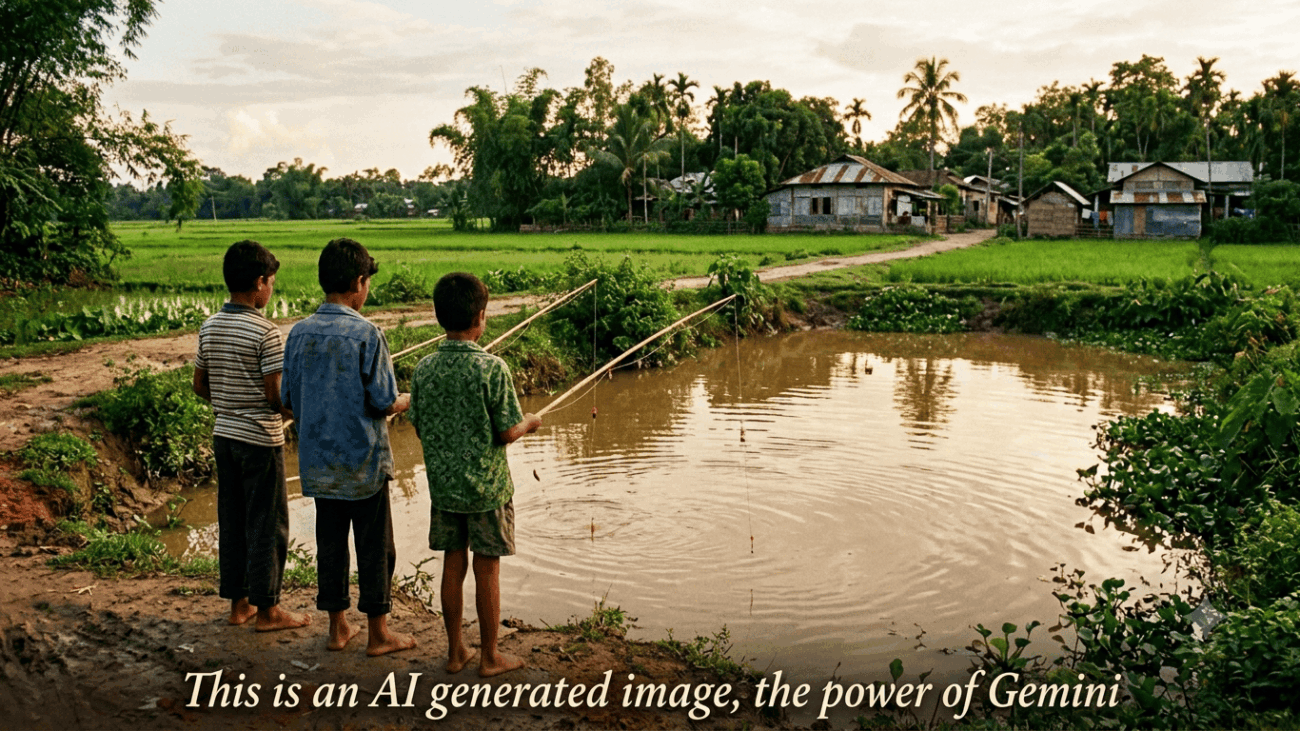
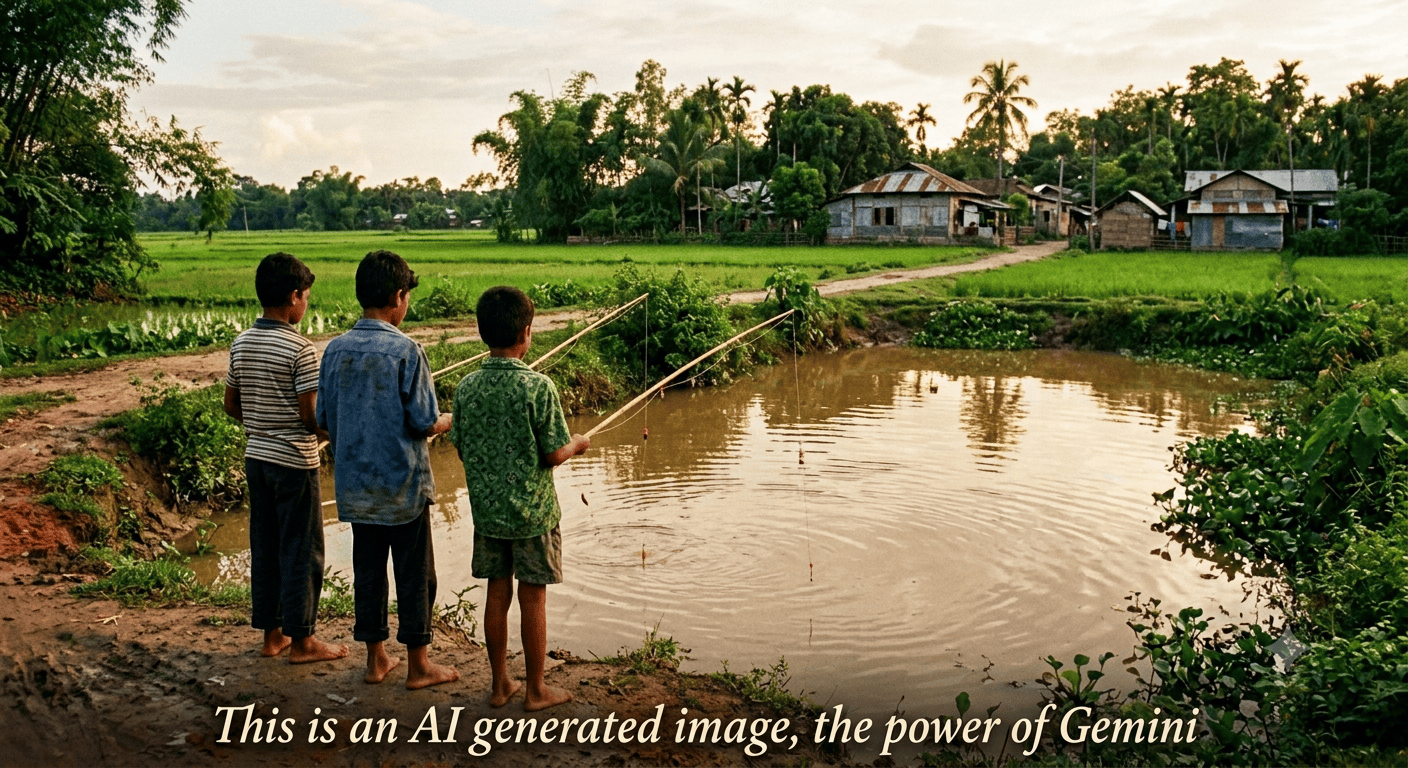
The sun used to hang low over those endless, emerald gardens, towering trees, the bamboo grooves, casting a liquid gold hue across the fields where I loved to roam. I can still vividly picture standing at the edge of the familiar village pond, its surface shimmering like a thousand scattered diamonds under the warm, humid sky. Memories flood back, pulling me irresistibly into that untamed joy. Oh, how I miss those golden evenings after school, the electric, sweet freedom that hit the moment the final bell rang.

With my makeshift fishing rod, a slender, springy bamboo branch tied with a simple length of string and a hook, after reaching home, I would race down the red-dirt path, my heart hammering a frantic rhythm against my ribs. As I reached the water’s edge, the air thick with the earthy scent of damp soil and the distant calls of egrets settling into the bamboo groves, the world became my own secret kingdom. My friends are already there.

I’d cast my line and wait. At first, there would be just a tentative, ghost-like brush against the string. My breath would hitch, every muscle locking into absolute, breathless stillness. Then, Wham! A violent, electric tug would nearly wrench the bamboo branch from my sweaty palms. A wild local puthi or a feisty kawoi had taken the bait. The string would cut a frantic, zig-zagging scar across the pond’s surface, sending shockwaves of pure adrenaline straight up my arms. With a breathless, triumphant heave, I’d whip the rod upward, sending a shimmering, silvery flash arching through the golden air. In that split second, the universe narrowed down to just me, the struggling catch, and the roaring triumph in my chest.

And then there were the rainy days, when the monsoon rains drummed a steady, comforting rhythm against the corrugated tin roofs of our village, turning the lush green gardens, fields into a vibrant, mist-veiled labyrinth. During those sudden downpours, I would sit on the veranda of our ancestral home, watching the swollen raindrops pitter-patter into the muddy puddles of the courtyard. Even when the rain kept me from my favorite fishing spots, it offered a cozy warmth: the distant chatter of neighbors sheltering beneath woven cane japi umbrellas, and the quiet contemplation of nature resting. The wait for rain seemed as eternity and in somedays we just went drenching in the rain, without the knowledge of our parents.

Back then, I thought I was just passing time, dodging the weight of school expectations. But the traits I absorbed by that water’s edge quietly shaped the very foundation of who I am today.

Now, when life calls me back to my daily responsibilities, whether it’s watering my thirsty garden plants or heading out with a sickle to cut fresh, sweet grass for our cows, I carry those childhood lessons with me:

  • Patience : Waiting hours for a bite taught me that life unfolds on its own schedule.
  • Perseverance: Tending to my plants today reminds me that growth cannot be rushed; it takes quiet, daily dedication.
  • Living in the Present: The intense focus required to watch that bobber taught me a grounding mindfulness. It allows me to find peace even in repetitive daily chores.
  • Harmony with Nature: Respecting the natural rhythm of the pond translated into a deep reverence for the land, guiding how I nurture my garden and care for our animals today.
  • Finding Joy in Simplicity: A simple bamboo branch, a piece of string, and a quiet afternoon were all I needed for complete happiness. It taught me early on that true fulfillment comes from within, not from material abundance.

Looking back, my heart swells with a profound sense of gratitude. I am deeply thankful to my parents, whose quiet wisdom, warm home, and unconditional love gave me the freedom to explore, dream, and grow. And to my childhood friends, my partners in crime who shared those muddy paths, the laughter under the monsoon rains, and the unbridled thrill of every catch, thank you for making my youth a canvas of unforgettable joy. I am who I am today because of the roots we planted together in that rich Assam soil.

A Closing Prayer & Gratitude

Gemini_Generated_Image_wunuefwunuefwunu

The Weight of a Ticket, The Lightness of a Smile

Flights get delayed—it feels like a universal law of travel. You sit, you wait, and you eventually board, bracing yourself for the usual routine. But today had a few extra twists waiting in the wings.

Stepping onto the plane, I noticed a spacious business class cabin up front. Two of my colleagues were already up there, lounging comfortably with plenty of breathing room, leaving four out of the eight seats completely vacant. Maybe today is my lucky day, I thought. After all, I had originally booked an emergency exit row—the holy grail of economy legroom.

But luck decided to test me instead.

Due to a last-minute aircraft change, my seat was reassigned to 15D—one row back, reduced to a thoroughly ordinary, unremarkable middle-of-the-pack seat. Oh well, I sighed to myself. You win some, you lose some.

The Man in 15E

Fate, it turned out, had a very different kind of upgrade in mind for me. Not for my legs, but for my perspective.

I ended up striking up a conversation with the man sitting next to me in 15E. As we talked, he shared a piece of his life that instantly silenced my inner complaints. He had recently been in a horrific accident that left him unconscious for ten days. When he finally woke up, an entire month of his life was simply gone—erased from his memory without a trace.

To pay the crushing medical bills, he was forced to sell his beloved Bullet motorcycle at a massive 60% loss. And now, still recovering, he was flying back to resume his work as a security guard for a private firm in Goa.

What struck me wasn’t just the sheer tragedy of his story; it was him.

As he spoke, he smiled. There was no bitterness in his voice, no anger at the world, not a single drop of negativity. Just pure, unfiltered gratitude for being alive and moving forward. Sitting beside him, my minor annoyance over losing an exit-row seat felt impossibly small. He gave me a humbling reality check, reminding me how much I have to be thankful for.

A Warm Welcome in Delhi

When we landed in Delhi, I was met by a driver assigned to pick me up. It happened to be his very first day with the agency. He was incredibly polite, though he didn’t know the exact location of my guest house—just the major landmark nearby.

As we navigated the traffic, I called my regular guest house manager to sort out the final directions, speaking in Hindi. The driver listened quietly as he drove. Just as we approached the destination, he looked back at me and softly said:

“The way you talk… your Hindi and its warmth will make anyone happy.”

His words stopped me in my tracks. I was genuinely touched by his gentle observation. I told him he had just made my day, but he shook his head with a smile and replied that I had made his first day on the job one he would always remember.

As I signed the duty slip, I handed him a small tip—specifically asking him to treat himself to a good cup of hot tea and snacks after a long drive. Before we parted, I shared a simple thought with him: Always keep smiling, because your smile is the one thing in this world that is entirely under your control.

Reflections on the Journey

Looking back, it was a day of minor setbacks—a delayed flight, a downgraded seat, and lost directions. But it was completely transformed by two incredible human beings: a resilient stranger in seat 15E who lost a month of his life yet kept his joy, and a new driver whose kind words cost nothing but meant everything.

It brought to mind one of my favorite quotes by Charles R. Swindoll:

“Life is 10% what happens to us and 90% how we react to it.”

I walked away from the airport feeling lighter, richer, and deeply grateful. It was a great day indeed.

Gemini_Generated_Image_ngkwkqngkwkqngkw

The Night Dr. Daniel Hale Williams Changed Medicine Forever

The Night a Bold Surgeon Rewrote Medical History. In 1893, Dr. Daniel Hale Williams risked everything to perform a historic, “impossible” heart surgery under the gaze of six witnessing doctors. Read the incredible true story.

On a humid summer night in Chicago, 1893, a man named James Cornish was rushed to Provident Hospital, clinging to life after a knife wound to the chest.

In those days, a stab wound to the heart was an absolute death sentence. The prevailing medical wisdom of the 19th century was absolute: the human heart was a sacred, untouchable border. To operate on a beating heart was considered impossible, and any surgeon daring enough to try would be accused of malpractice.

But the doctor on duty that night was no ordinary physician. His name was Dr. Daniel Hale Williams.

Dr. Williams had already defied the odds just by existing in his field. As a Black surgeon in an era of rampant racial prejudice, he had recently founded Provident Hospital—the country’s first medical facility with an interracial staff—to ensure patients of all colors could receive dignified care.

Knowing the immense skepticism he faced as a Black professional, Dr. Williams did something extraordinary before picking up his scalpel: he pulled six other doctors—four white and two Black—into the cramped operating room. They weren’t there to assist. They were there to be witnesses. If the patient died, they would prove he followed protocol; if the patient lived, they would validate a miracle.

With the six doctors watching in hushed silence, Dr. Williams opened the chest cavity. He found a severed artery and a deep, angry tear in the pericardium—the protective sac surrounding the heart.

Relying on sheer instinct, immaculate skill, and without the modern luxury of antibiotics or blood transfusions, Dr. Williams did the unthinkable. He reached in, held the wounded tissue, and carefully sutured the tear just inches away from the rhythmically thumping heart.

Fifty-one days later, James Cornish didn’t just survive—he walked out of the hospital on his own two feet. He would go on to live for another twenty years.

Dr. Daniel Hale Williams didn’t just save a life that night; he shattered a medical barrier that had stood for centuries. His story is a powerful reminder of what happens when profound skill meets the audacity to hope, proving that true pioneers are those who look at an “impossible” boundary and choose to cross it anyway.