In today’s volatile market, I kept looking for a historical anchor—and I found it in an 87-year-old billionaire…
Sequel 1: The Art of Maximum Pessimism
How an Iconoclast Built a Global Fortune From Ruins
Let’s be honest about the market right now. Every time you open a financial app, you are bombarded by the same intoxicating narrative. We are watching astronomical capital poured into Artificial Intelligence infrastructure, mega-cap tech valuations stretched to their absolute limits, and a retail crowd that swings violently between euphoria and sheer exhaustion. It feels entirely new. It feels unprecedented.
Whenever I find myself overwhelmed by the daily noise of market tickers, I don’t look at the current charts. I look backward. And lately, I keep coming back to one man: Sir John Templeton.
Templeton wasn’t just an investor; he was a financial iconoclast who mastered the psychology of the crowd. He pioneered global investing when Wall Street was strictly provincial, deliberately moved to the Bahamas just to get away from the “groupthink” of the trading floor, and built a legendary fortune by running toward the things that terrified everyone else.
Whether you are trying to navigate today’s volatile tech landscape or simply looking for the courage to zig when the rest of the world zags, Templeton’s playbook is the ultimate masterclass.
This is Part 1 of our look at the billionaire who with his blueprint for radical conviction looked at a world on the brink of collapse and saw an open invitation to wealth.
Born in 1912 in Winchester, Tennessee, Templeton was forged in the Great Depression. After his studies, he set off on a remarkable journey, backpacking through 35 countries and realized that the world was vastly interconnected, and from the deepest systemic crises, new paradigms of growth always emerged.
The $10,000 War Bet
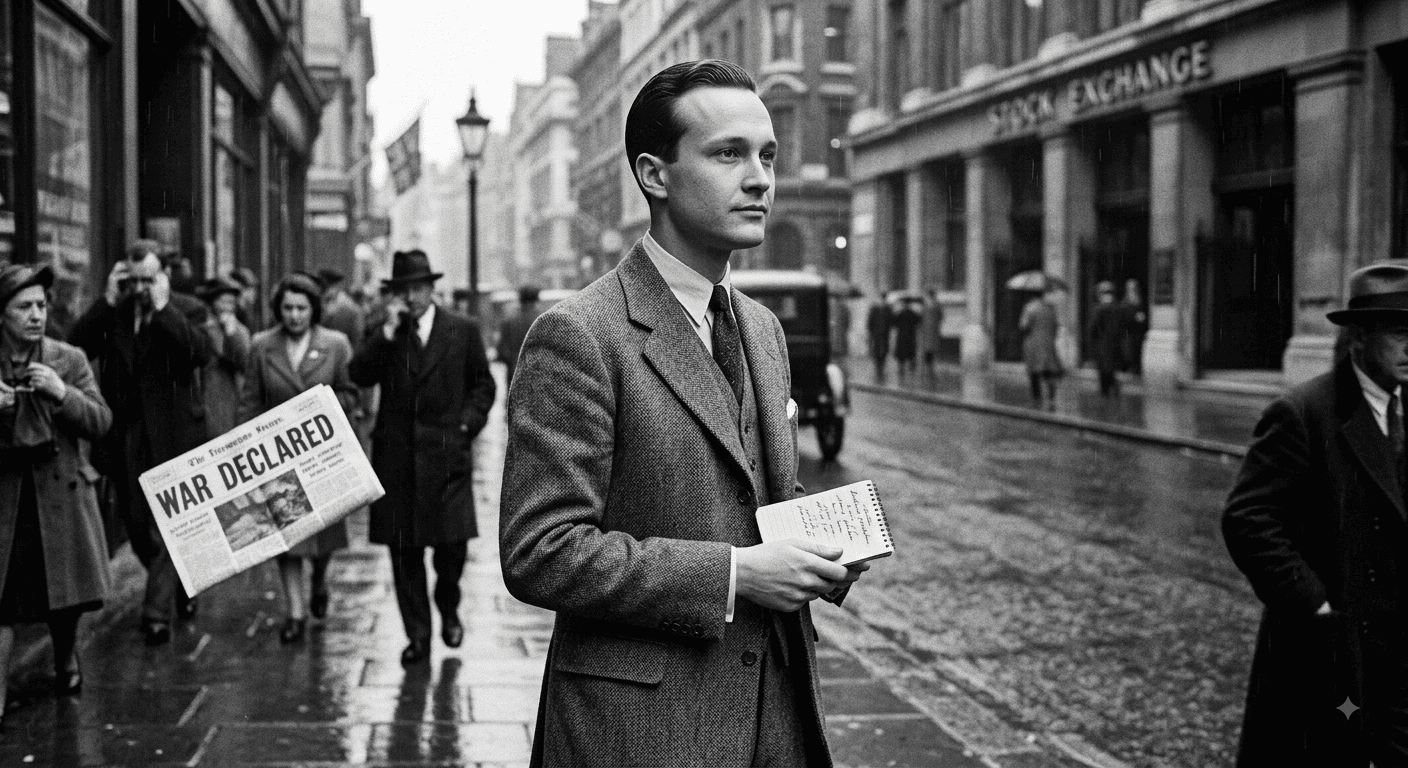
Templeton’s official investment journey began in 1937, but his true legendary status was cemented in 1939, just days after Hitler invaded Poland.
As the world spiraled into panic, Templeton did research. War forces governments to spend massively and sectors like railroads, steel, heavy manufacturing, many of which were rotting in bankruptcy post-Depression, would suddenly become vital.
He called his broker and gave a wild directive: “Buy me $100 worth of every stock trading under $1 a share.” When his broker frantically called back to inform him that 37 of the 104 companies on the list were actively in bankruptcy, Templeton famously replied: “Oh, no. Those are the best of all.”
He was right, surplus turned to scarcity and Rail stocks like the Missouri-Pacific Railway, skyrocketed. Within a few years, only four of his picks turned out worthless; the rest quadrupled his investment, kicking off one of the greatest fortunes in financial history.
Pioneering the Global Stage
In 1954, long before “global diversification” was a financial buzzword, he launched the Templeton Growth Fund. Armed with his cross-border insights, he bought rock-bottom Japanese stocks in the 1960s, capitalizing on an economic miracle before anyone else noticed.
Between 1954 and his retirement in 1992, his fund generated an astronomical 15% average annual return. A $10,000 investment made at the fund’s inception would have grown into roughly $2 million by the time he stepped away.
But to achieve this, Templeton had to do something drastic. In 1968, he packed his bags and moved to the Bahamas. While critics murmured about tax shelters, Templeton’s primary motivation was psychological.
He knew that to beat the herd, you couldn’t breathe the same air as the herd.
By reading the Financial Times days late on a Caribbean beach, he insulated his mind from the daily noise of Wall Street ticker tape. In 1992, at age 80, he sold his empire to Franklin Resources and walked away into a life of billionaire philanthropy. His investing story seemed complete.
Until the calendar flipped to the year 2000.
I would love to hear from you and grateful for you reaching here… With love and gratitude, till we met next week…May God Bless.