The Two Secret Engines Inside Your Brain:
We like to think we are always smart and logical with our money. We imagine our minds as calm, careful courtrooms where every purchase or life choice is weighed with perfect precision.
But let’s be honest. Have you ever gone to the market with a strict budget, got overwhelmed by the crowds, and ended up buying things you didn’t need just because they looked flashy?
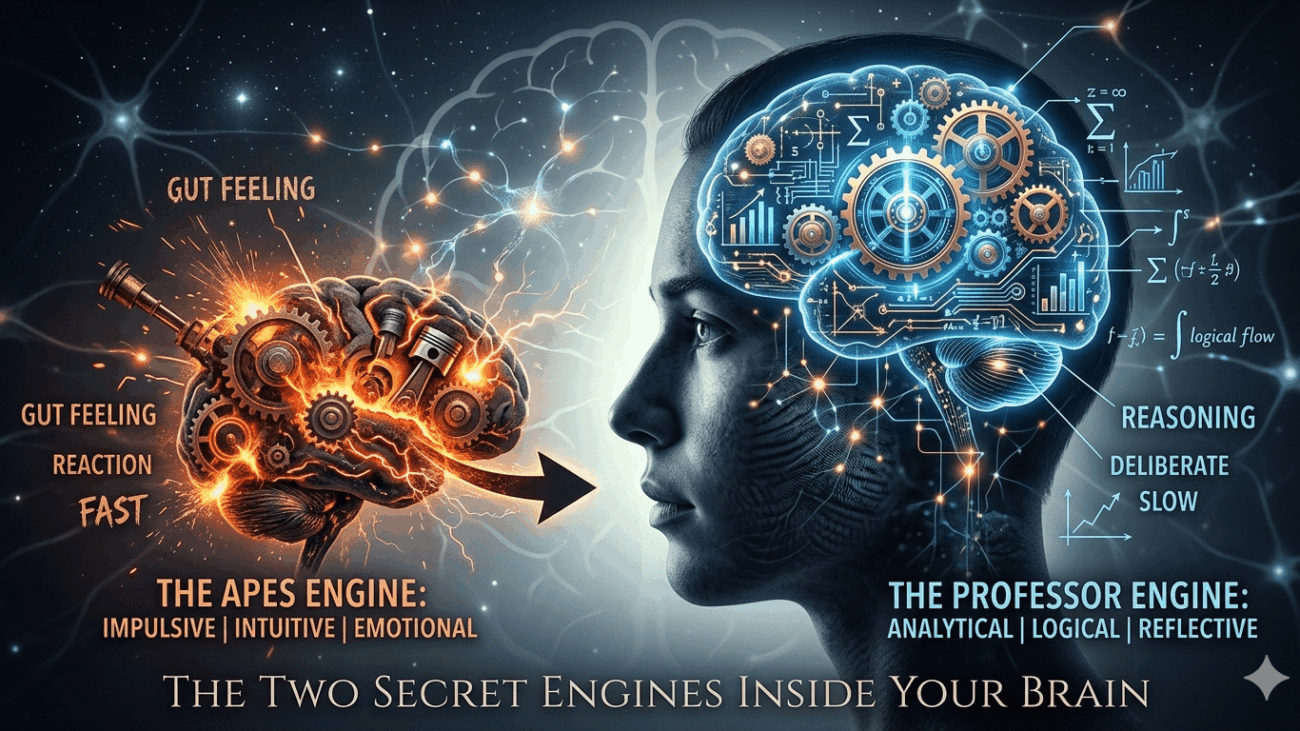
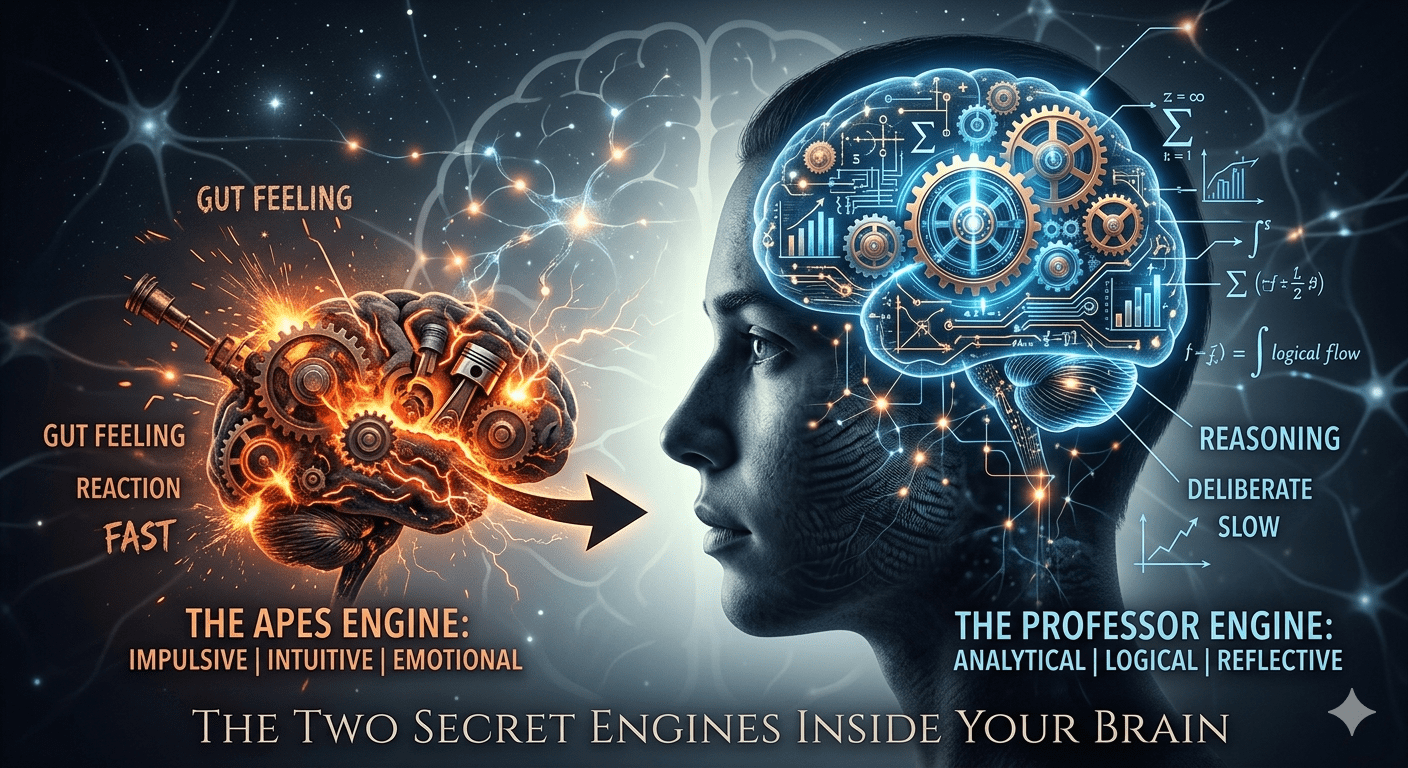
Psychologist Daniel Kahneman won a Nobel Prize for explaining exactly why we do this. He revealed that your brain does not have just one way of thinking. Instead, it relies on two completely different internal engines to get you through the day: System 1 (The Autopilot) and System 2 (The Detective).
“System 1 runs automatically and System 2 is normally in a comfortable low-effort mode, in which only a fraction of its capacity is engaged.” — Daniel Kahneman
“System 2 is activated when an event is detected that violates the model of the world that System 1 maintains.” — Daniel Kahneman
Understanding these two systems is the secret to knowing why we make impulsive mistakes, how shops trick us, and why technology is changing our choices forever.
Let’s meet our Brain’s 2 Engines
🧠 The Fast Autopilot or System 1
System 1 operates automatically, instantly, and completely behind the scenes. It requires zero conscious effort or energy. It runs on gut instinct, emotions, habits, and quick mental shortcuts. System 1 is our brain’s survival mode.
Some easy examples of this mode are, we slam on our car brakes when a dog runs into the road, we can instantly recognize an angry face, immediately tell that 2+2=4. It is incredibly fast, but the major flaw is that as it is highly impulsive it can be easily tricked by illusions or clever advertisements.
🕵️♂️ The Slow Detective or System 2
System 2 is our conscious, deliberate, and logical mind. It handles the heavy lifting, like complex math, deep analysis, and self-control. It is the part of your brain that ‘you actually think of as “you.”
When do we use System 2, we use it when we try to calculate something difficult in our head, or search carefully for a specific address in an unfamiliar neighbourhood. But the major weakness of System 2 is that it is fundamentally lazy. Our brain burns a massive amount of energy when System 2 is working hard. Hence, to save energy, our brain constantly tries to shut the Detective down and moves towards the Autopilot mode.
The Retail Trap: Why Your Detective Goes to Sleep
Because your brain treats System 2 like a scarce battery, you navigate almost 90% of your daily life using the fast shortcuts of the System 1 Autopilot. Supermarkets and online stores understand this biology perfectly. They design crowded, noisy, and bright environments specifically to exhaust your Detective and exploit your Autopilot.
“Nothing in life is as important as you think it is, while you are thinking about it.” — Daniel Kahneman
Imagine walking into a chaotic festive market. You start with a great System 2 plan: you will compare prices, check labels, and stick strictly to your budget.
But within half an hour, your mental battery drains. The bright neon signs, loud music, pushy salespeople, and endless choices force your brain to do too much work. Your logical Detective gets exhausted and falls asleep.
Suddenly, your Autopilot takes the wheel. You see a flashy red “Special Deal!” sign on a luxury item you don’t even need. Instead of doing the math, your Autopilot sees the bright color, gets excited, and throws it into the bag. You didn’t make a smart, rational choice; your tired brain simply took the easiest route out.
The Future: AI as a Tireless Detective
This biological reality is why humans can never be perfectly logical all the time. Our brains simply run out of battery. This is exactly where the rise of Artificial Intelligence changes everything.
An advanced AI assistant is essentially a permanent, tireless version of System 2. It has infinite energy, never runs out of fuel, and completely lacks a flawed, emotional Autopilot.
By letting software handle our budgets, compare prices, and manage our shopping, we are replacing our exhausted human Autopilot with a sleepless digital Detective. We might finally achieve perfect financial efficiency—not by fixing our broken human logic, but by handing our choices over to a machine that never needs to sleep.