Gemini_Generated_Image_wunuefwunuefwunu

The Weight of a Ticket, The Lightness of a Smile

Flights get delayed—it feels like a universal law of travel. You sit, you wait, and you eventually board, bracing yourself for the usual routine. But today had a few extra twists waiting in the wings.

Stepping onto the plane, I noticed a spacious business class cabin up front. Two of my colleagues were already up there, lounging comfortably with plenty of breathing room, leaving four out of the eight seats completely vacant. Maybe today is my lucky day, I thought. After all, I had originally booked an emergency exit row—the holy grail of economy legroom.

But luck decided to test me instead.

Due to a last-minute aircraft change, my seat was reassigned to 15D—one row back, reduced to a thoroughly ordinary, unremarkable middle-of-the-pack seat. Oh well, I sighed to myself. You win some, you lose some.

The Man in 15E

Fate, it turned out, had a very different kind of upgrade in mind for me. Not for my legs, but for my perspective.

I ended up striking up a conversation with the man sitting next to me in 15E. As we talked, he shared a piece of his life that instantly silenced my inner complaints. He had recently been in a horrific accident that left him unconscious for ten days. When he finally woke up, an entire month of his life was simply gone—erased from his memory without a trace.

To pay the crushing medical bills, he was forced to sell his beloved Bullet motorcycle at a massive 60% loss. And now, still recovering, he was flying back to resume his work as a security guard for a private firm in Goa.

What struck me wasn’t just the sheer tragedy of his story; it was him.

As he spoke, he smiled. There was no bitterness in his voice, no anger at the world, not a single drop of negativity. Just pure, unfiltered gratitude for being alive and moving forward. Sitting beside him, my minor annoyance over losing an exit-row seat felt impossibly small. He gave me a humbling reality check, reminding me how much I have to be thankful for.

A Warm Welcome in Delhi

When we landed in Delhi, I was met by a driver assigned to pick me up. It happened to be his very first day with the agency. He was incredibly polite, though he didn’t know the exact location of my guest house—just the major landmark nearby.

As we navigated the traffic, I called my regular guest house manager to sort out the final directions, speaking in Hindi. The driver listened quietly as he drove. Just as we approached the destination, he looked back at me and softly said:

“The way you talk… your Hindi and its warmth will make anyone happy.”

His words stopped me in my tracks. I was genuinely touched by his gentle observation. I told him he had just made my day, but he shook his head with a smile and replied that I had made his first day on the job one he would always remember.

As I signed the duty slip, I handed him a small tip—specifically asking him to treat himself to a good cup of hot tea and snacks after a long drive. Before we parted, I shared a simple thought with him: Always keep smiling, because your smile is the one thing in this world that is entirely under your control.

Reflections on the Journey

Looking back, it was a day of minor setbacks—a delayed flight, a downgraded seat, and lost directions. But it was completely transformed by two incredible human beings: a resilient stranger in seat 15E who lost a month of his life yet kept his joy, and a new driver whose kind words cost nothing but meant everything.

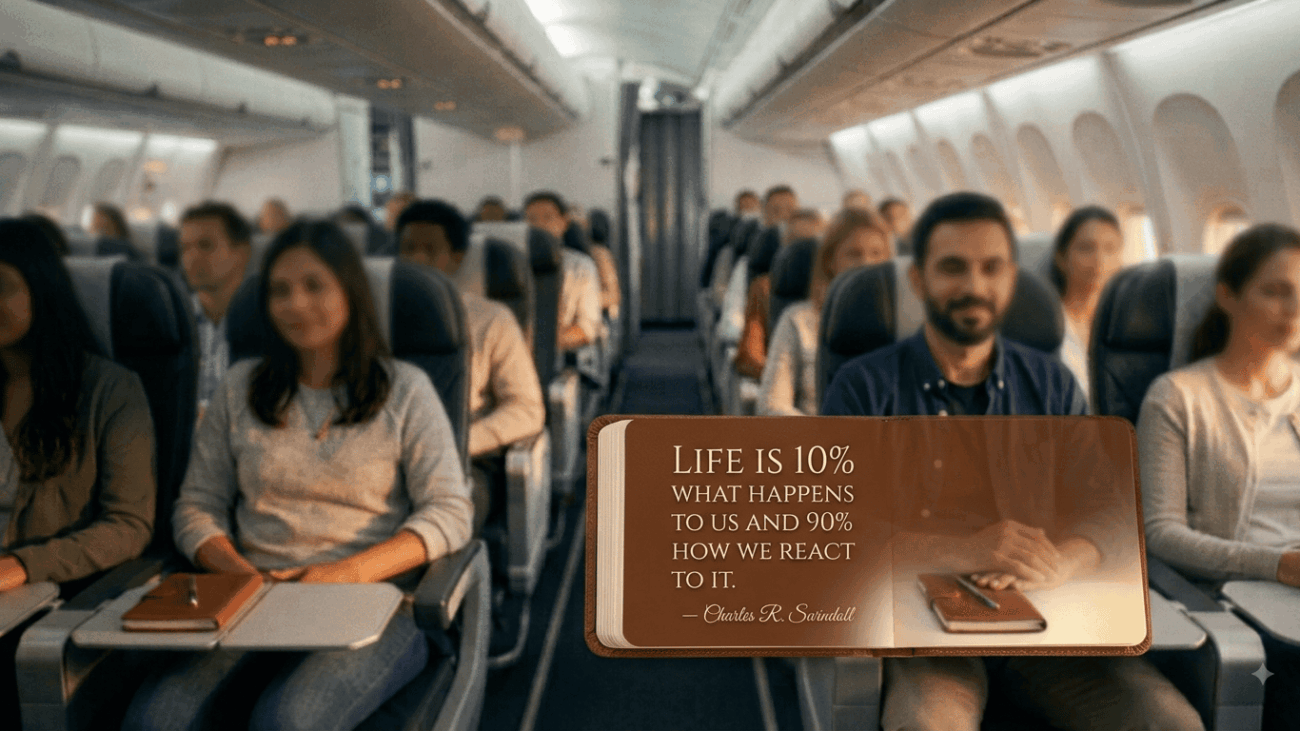
It brought to mind one of my favorite quotes by Charles R. Swindoll:

“Life is 10% what happens to us and 90% how we react to it.”

I walked away from the airport feeling lighter, richer, and deeply grateful. It was a great day indeed.
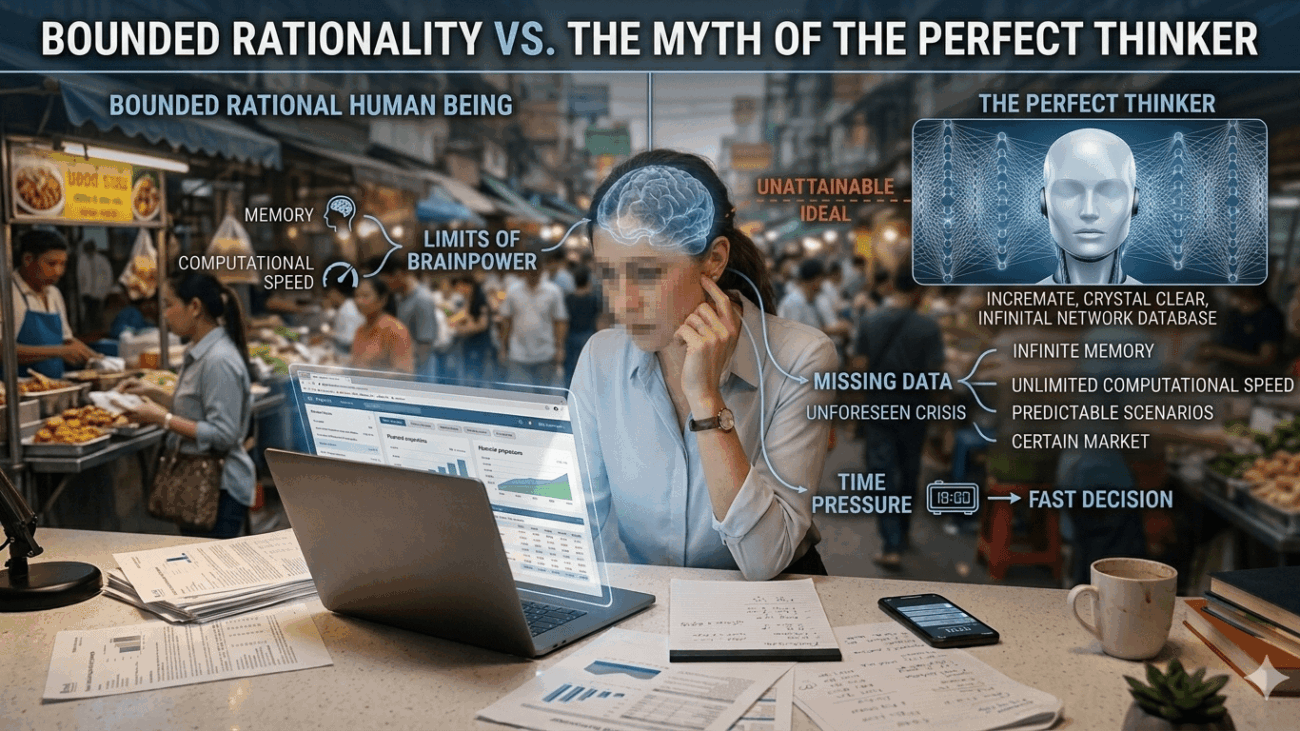
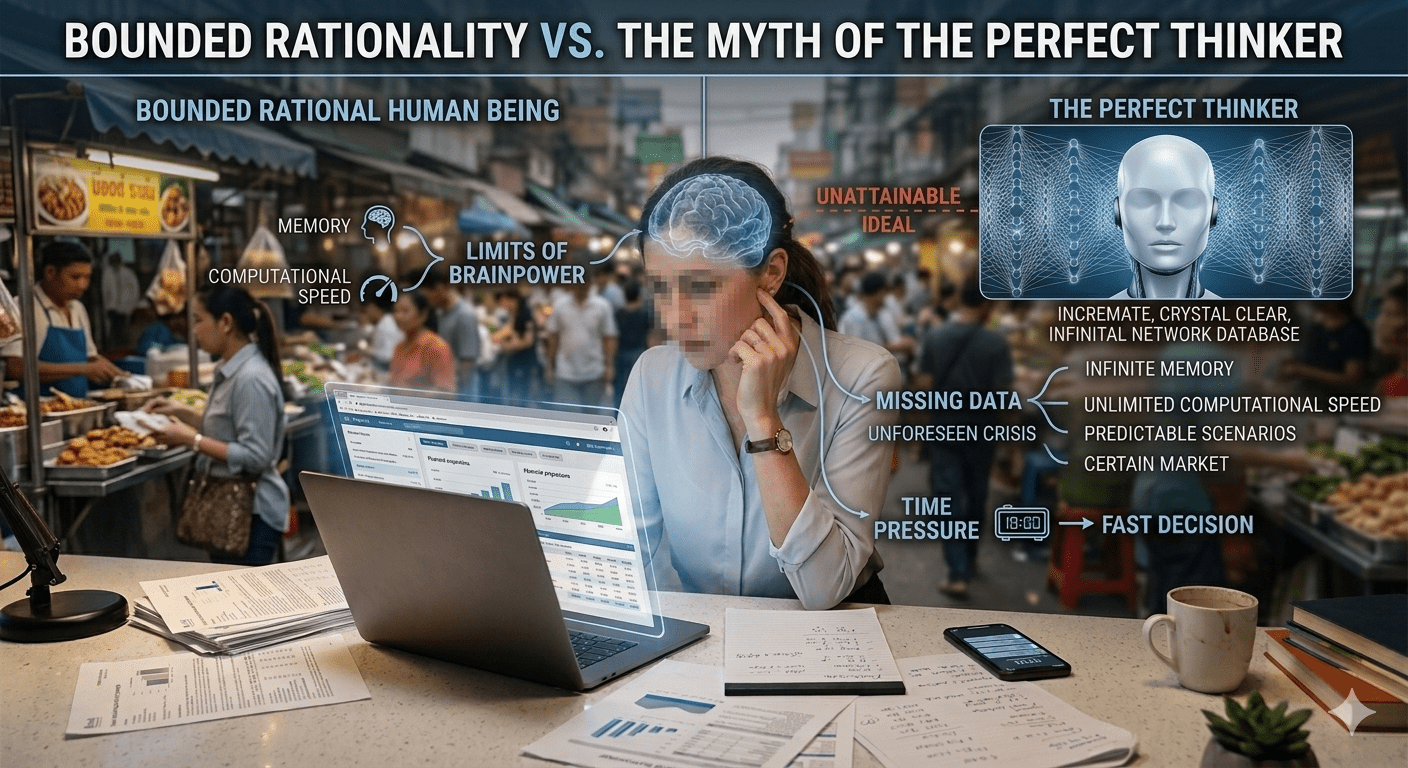
image_586cf34e

The Myth of the Perfect Thinker: Why You are a “Bounded Rational” Human Being?

We like to think we make flawless financial choices. We imagine ourselves weighing every option, calculating every discount, and picking the absolute best deal, i.e the perfectly logical creature of economics textbooks, the “Economic Man.”

But let’s be honest. Have you ever walked into a market, completely overwhelmed by the noise, the traffic, and thirty different vendors yelling out prices for the same bananas, and just bought from the first stall/ vendor you saw? If you have, they you are a normal human being, congrats.

A brilliant thinker named Herbert Simon looked at how humans actually make choices. He researched extensively and came to the concuslion that we, humans are not supercomputers. We as humans, normally weighing the options, not every available option; calculating discounts, not every discount, and then picking up the best deal as we presume, which may not be the best, but we are satisfied and make the purchase/ deal.

Simon first laid out the core idea that human decision-making is limited by cognitive capacity and organizational constraints, challenging the classical economics assumption of perfect rationality. He then introduced the foundational concept of Bounded Rationality in his landmark 1947 book, Administrative Behavior.

Simon argued that human rationality is “bounded” (or limited) by three major things: the limited information we have, the limited processing power of our brains, and the limited time available to make a decision.

Instead of searching forever for the perfect choice, humans practice what Simon called “satisficing”—a combination of satisfying and sufficing. We choose the option that is simply “good enough.”

Let us discuss Bounded Rationality in more simpler terms.

1. The Boundary of Information (We Can’t Know Everything)

The “Economic Man” knows the exact price and quality of every product everywhere. In reality, we operate in a fog.

Imagine you are shopping for a Muga Silk Mekhela Chador for a wedding. To be a purely economic thinker, you would need to visit every single weaver in Sualkuchi, check every shop in Fancy Bazar, and test the exact chemical purity of the silk threads in a lab. Because you cannot possibly access or process that much data, you rely on trust. You buy from a shop your aunt recommended, hoping the quality is good and the price is fair. Your decision is rational, but it is bounded by the information you have.

2. The Boundary of Brainpower (Our Brains Get Tired)

Our brains cannot calculate complex mathematical probabilities on the fly. When faced with too many choices, our mental processors overheat.

Think about booking a holiday trip to Kaziranga National Park. You are flooded with choices: dozens of resorts, varying jeep safari packages, hidden resort fees, and fluctuating fuel costs. A supercomputer would calculate the exact utility-to-cost ratio of every single combination. Your human brain, however, experiences “choice overload.” After scrolling through three travel websites, you get tired, pick a mid-range resort with decent photos, and say, “This looks fine.” You didn’t find the absolute best mathematical deal, but you found one that satisfies your basic needs.

3. The Boundary of Time (The Clock is Ticking)

In textbooks, decisions happen in a vacuum. In the real world, time runs out.

Imagine the chaotic rush hour at the Jalukbari rotary in Guwahati. You need to get to Khanapara quickly. To be purely rational, you should pull over, analyze live satellite traffic data for three different routes, calculate the wear-and-tear cost on your vehicle per minute of idling, and check real-time fuel prices. But you don’t have twenty minutes to sit and calculate. The bus behind you is honking, cars are cutting you off, and you are already late. You make a split-second decision based on your gut instinct and take the bypass. It might not be the mathematically perfect route, but it gets you moving.

The Beauty of Being “Good Enough”

Herbert Simon’s concept of bounded rationality changes how we view ourselves. It proves that when we make “impulsive” or “imperfect” choices, we are not necessarily being stupid or lazy. We are simply adapting to a complex world with limited cognitive resources.

The “Economic Man” is a lonely, robotic fiction. He spends his entire life calculating, never experiencing the joy of a spontaneous purchase or the comfort of a trusted local vendor.

By accepting our bounded rationality, we realize that human survival doesn’t require us to be perfect. In a world full of infinite data and chaotic markets, being “good enough” is actually the smartest choice we can make.

Gemini_Generated_Image_1ccea91ccea91cce

The Architecture of a Meaningful Life: From Russell’s Wisdom to the Digital Age

“The purpose of our lives is to be happy.” Dalai Lama

What is the ultimate goal of life? It’s a question that often catches up with us during quiet moments or at major crossroads. When we don’t have a clear sense of purpose, it’s easy to feel “adrift”, as if we are reacting to life rather than living it.

The truth is that a meaningful life isn’t found in social status or the accumulation of wealth. It is built, brick by brick, through the deliberate pursuit of happiness and the cultivation of a peaceful mind.

Happiness as an Achievement

We often think of happiness as something that “happens” to us, but the philosopher Bertrand Russell argued in The Conquest of Happiness (1930) that it is actually an achievement. It requires effort to overcome the psychological traps that steal our peace, the traps that have only become more sophisticated in the 21st century.

What comes to my mind is the beautiful and meaningful quote of Russel, “To be without some of the things you want is an indispensable part of happiness.”  

Even today, the 3 main culprits of our unhappiness as pointed out by Russell are universal truth:

  1. The Ego: An unhealthy preoccupation with our own importance and how we are perceived.
  2. Envy: The exhausting habit of measuring our worth against others.
  3. Competition: The relentless “rat race” that treats life like a struggle to be won.

The Digital Evolution: From Envy to FOMO

While Russell was writing in the 1930s, his insights feel like a prophetic blueprint for the smartphone era. What he called “Envy,” we now experience as FOMO (Fear of Missing Out).

Social media has digitized the comparison trap. We always compare our “behind-the-scenes”, i.e. our real, messy lives with everyone else’s “highlight reel.” Our Ego becomes tied to the dopamine loop of likes and notifications, leading to the “nervous fatigue” which Russell warned about nearly a century ago.

Today, we aren’t afraid we won’t have bread for breakfast; we are afraid we aren’t outshining our neighbours on a global scale.

My Take: Hobbies: Our Secret ‘Other World’

To combat this digital noise, we need a strategy to stabilize our minds. This is where the ‘art of making life colourful’ comes in. Developing a hobby, like gardening, reading, photography, or philanthropy is not just a way to pass the time, in today’s world it is a therapeutic necessity.

The playwright George Bernard Shaw once captured this perfectly, “The person who has a hobby may be said to have another world at his command.”

Buddhist philosophy echoes this through the concept of ‘Right Mindfulness.’ When you are fully immersed in a hobby, you are practicing ‘meditation in action.’ In those moments, the ego falls away as we are not competing for ‘reach’ or ‘likes’, rather we are simply being.

The Healing Power of the Natural World

While hobbies ground our minds, nature grounds our souls. There is a profound sense of gratitude to be found in the stillness of a forest or the majesty of a mountain. I do really find it, amidst nature rejuvenates me.

In The Monk Who Sold His Ferrari, Robin Sharma reminds us that a close connection with nature frees us from the noise of modern greed. Nature doesn’t have a refresh button or a newsfeed. By slowing down to match the pace of the natural world, we align ourselves with a simpler, more authentic version of ourselves.

“Nature does not hurry, yet everything is accomplished”, another age-old wisdom by LaoTzu

If you are ready to pivot toward a more joyful existence, you don’t need a radical overhaul.

It’s time to ‘Call for Action, for Reclaiming our Joy’

What comes to my mind are the following active shifts to our perspective and the actionable points to be undertaken:

  1. To Practice ‘Selective Ignorance’. Start may be to unfollow accounts that trigger our comparison-envy. Next will be to replace our passive scrolling with an active hobby that builds a skill or creates something tangible leading to joy and satisfaction.
  2. Creation of ‘Ego-Free Time’. Let’s dedicate some of our time each day to an activity that cannot be ‘posted.’ It is as simple as that to walk in the woods without taking a photo as this will be an experience that belongs entirely to you.
  3. ‘Competition to Admiration Shift’. It is said that ‘The antidote to Envy is Admiration’. Instead of feeling diminished by someone else’s success, lets us try and reach out to offer genuine praise. It will break the cycle of comparison.
  4. ‘Release’. To release the weight we hold within, free ourself, say from our obsession with material gain and also from past hardships. Look out for ‘Optimism’ the silver lining which is always there. The more we practice optimism, the more stronger and happy we become.

By seeking joy in these small, creative acts, we don’t just improve our own lives, we contribute to a world that is a little more peaceful, grounded, and colourful for everyone.