Unscheduled Upgrades: What a Delayed Flight and Two Strangers Taught Me About Perspective

Flights get delayed—it feels like a universal law of travel. You sit, you wait, and you eventually board, bracing yourself for the usual routine. But today had a few extra twists waiting in the wings.
Stepping onto the plane, I noticed a spacious business class cabin up front. Two of my colleagues were already up there, lounging comfortably with plenty of breathing room, leaving four out of the eight seats completely vacant. Maybe today is my lucky day, I thought. After all, I had originally booked an emergency exit row—the holy grail of economy legroom.
But luck decided to test me instead.
Due to a last-minute aircraft change, my seat was reassigned to 15D—one row back, reduced to a thoroughly ordinary, unremarkable middle-of-the-pack seat. Oh well, I sighed to myself. You win some, you lose some.
The Man in 15E
Fate, it turned out, had a very different kind of upgrade in mind for me. Not for my legs, but for my perspective.
I ended up striking up a conversation with the man sitting next to me in 15E. As we talked, he shared a piece of his life that instantly silenced my inner complaints. He had recently been in a horrific accident that left him unconscious for ten days. When he finally woke up, an entire month of his life was simply gone—erased from his memory without a trace.
To pay the crushing medical bills, he was forced to sell his beloved Bullet motorcycle at a massive 60% loss. And now, still recovering, he was flying back to resume his work as a security guard for a private firm in Goa.
What struck me wasn’t just the sheer tragedy of his story; it was him.
As he spoke, he smiled. There was no bitterness in his voice, no anger at the world, not a single drop of negativity. Just pure, unfiltered gratitude for being alive and moving forward. Sitting beside him, my minor annoyance over losing an exit-row seat felt impossibly small. He gave me a humbling reality check, reminding me how much I have to be thankful for.
A Warm Welcome in Delhi
When we landed in Delhi, I was met by a driver assigned to pick me up. It happened to be his very first day with the agency. He was incredibly polite, though he didn’t know the exact location of my guest house—just the major landmark nearby.
As we navigated the traffic, I called my regular guest house manager to sort out the final directions, speaking in Hindi. The driver listened quietly as he drove. Just as we approached the destination, he looked back at me and softly said:
“The way you talk… your Hindi and its warmth will make anyone happy.”
His words stopped me in my tracks. I was genuinely touched by his gentle observation. I told him he had just made my day, but he shook his head with a smile and replied that I had made his first day on the job one he would always remember.
As I signed the duty slip, I handed him a small tip—specifically asking him to treat himself to a good cup of hot tea and snacks after a long drive. Before we parted, I shared a simple thought with him: Always keep smiling, because your smile is the one thing in this world that is entirely under your control.
Reflections on the Journey
Looking back, it was a day of minor setbacks—a delayed flight, a downgraded seat, and lost directions. But it was completely transformed by two incredible human beings: a resilient stranger in seat 15E who lost a month of his life yet kept his joy, and a new driver whose kind words cost nothing but meant everything.
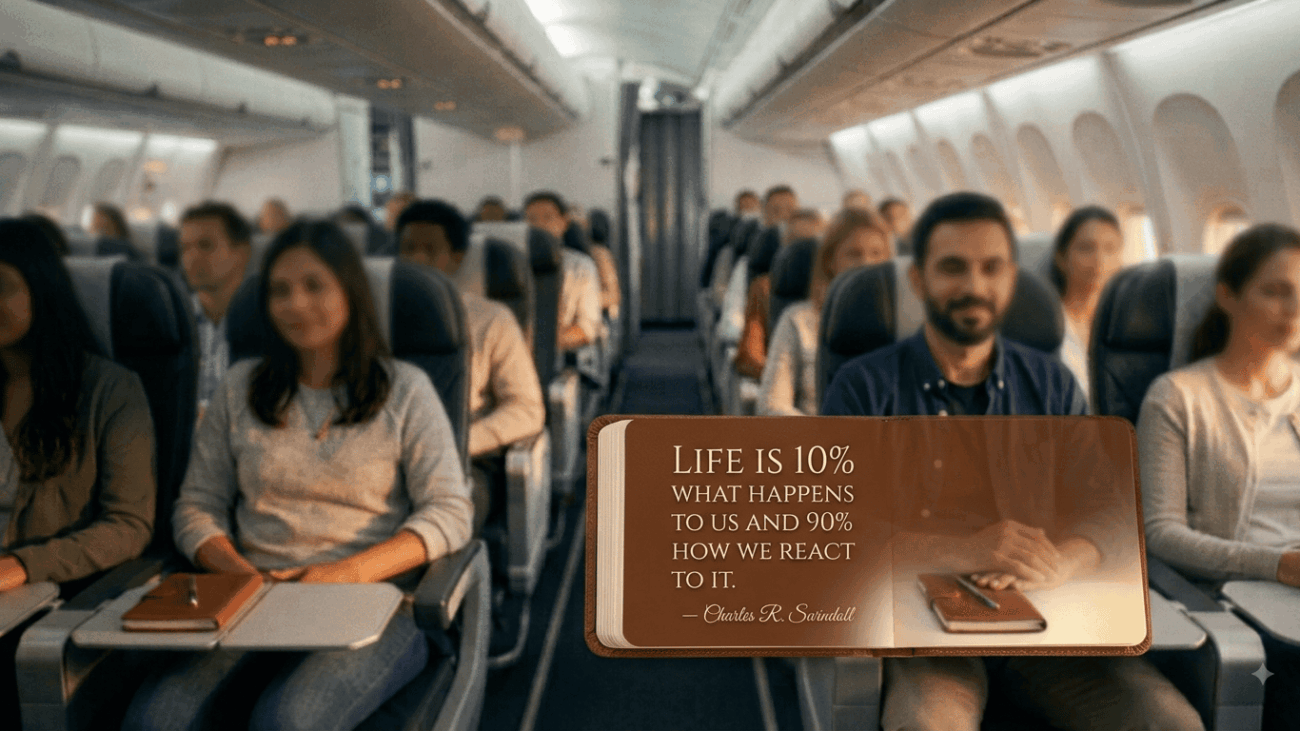
It brought to mind one of my favorite quotes by Charles R. Swindoll:
“Life is 10% what happens to us and 90% how we react to it.”
I walked away from the airport feeling lighter, richer, and deeply grateful. It was a great day indeed.

