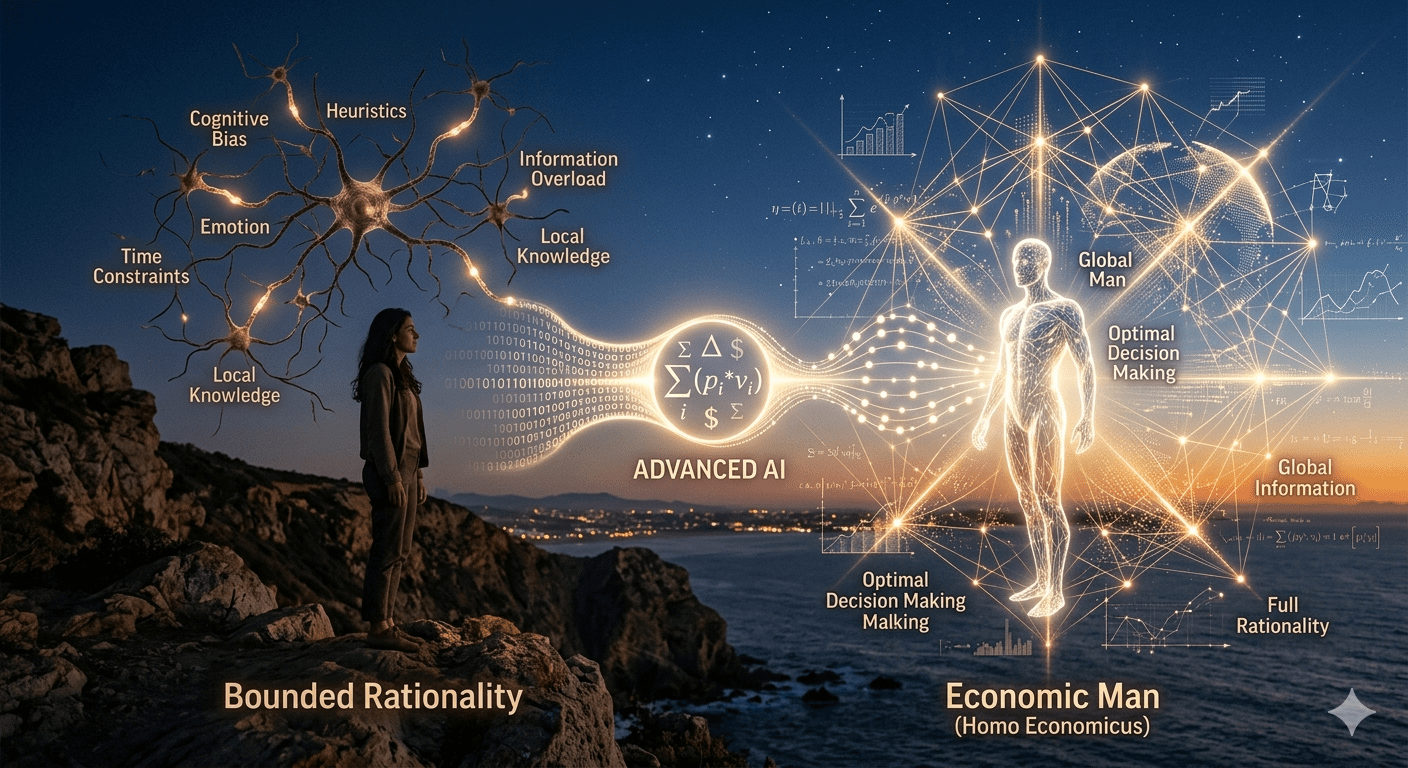
“The algorithm forces us to act with flawless logic, but it does so by wiping away the beautiful, messy spontaneity that makes us human.”
AI can finally turn humans into ‘Economic Man’ from our current state of ‘Bounded Rational’ players by acting as an automated, hyper-logical proxy that removes the biological limits of our brains. By managing our daily transactions, AI can strip away the three constraints that Herbert Simon identified in his theory of Bounded Rationality.
Human Logic has 3 boundaries, a) Limited Brainpower b) Missing Market Data and c) Panic, Fast Timing leading to bounded decision making. However, with the advent of AI, we humans will have all the Real Time Information for Infinite Computation and Instantaneous Execution leading to purely rational decision making which will make us strive towards the ‘Economic Man’.
Let us how dive a bit deeper.
1. Erasing the Information Gap
Real humans cannot know every price, tariff, or shipping fee on earth. We buy based on trust, guesswork, or whatever shop happens to be nearby. As such the classical “Economic Man” fails to exist.
An AI agent does not guess. It uses automated web scraping and instant data feeds to track the entire global economy at once.
The Difference in Action: Buying a High-End Laptop
The Bounded Human: You visit a couple of electronics stores or check one major online retailer. You get overwhelmed by technical jargon, worry about warranty terms, and just make a best guess.
The AI “Economic Man”: In milliseconds, your AI scans thousands of global suppliers, compares import duties across borders, calculates local delivery delays to Assam, and tracks historic price drops. It instantly secures the absolute best deal on earth, completely bypassing human information blindness.
2. Eliminating Choice Fatigue
Human brains get tired. When we are flooded with too many options, coupons, and combinations, our mental processors overheat. We experience “choice overload” and make impulsive decisions just to get the shopping over with.
An AI agent never gets tired, never feels stressed, and doesn’t care about flashy packaging. It operates purely on cold, hard math.
Let’s look into a very common example of booking a Family Trip
The Bounded Human: You look at 10/15 different websites, resort, compare packages, look up hidden resort fees, and try to calculate fuel costs. After an hour of staring at a screen, your brain gives up. You pick a mid-range hotel with nice pictures and say, “This is fine.” You didn’t get the best deal; you just stopped because your brain was exhausted.
The AI “Economic Man”: Your AI assistant evaluates millions of combinations of room availability, vehicle wear-and-tear, and seasonal price dips in less than a second. It is completely immune to clever marketing tricks, beautiful website designs, or emotional manipulation. It picks the mathematically perfect option without a single ounce of mental fatigue.
Here, AI with its upgraded ‘Processing Power’ operates rationally, no brand loyalty or nostalgia like human brains, completely immune to clever marketing tricks, visual packaging, or emotional manipulation, cognitive bias and provides option.
3. Eradicating Time Constraints
We, Humans are bound by the clock. In the real world, time runs out, traffic rushes by, and deadlines approach. When we are forced to make decisions in a panic, our logic completely breaks down.
An AI agent operates at computational speeds. It doesn’t experience panic, wait in traffic, or rush because a deadline is looming. It acts instantly and flawlessly, even while you sleep.
Booking a Ride in Rush Hour
The Bounded Human: Imagine you are standing at the crowded rotary during evening rush hour. It is getting dark, buses are honking, and you need to get to the location for an urgent meeting. You open a ride-hailing app, see a high surge price, and feel your stress rising. Because you don’t have 15/20 minutes to stand on the road comparing different apps, checking alternative routes, or waiting out the surge, you panic-click “Book.” Chances are there that you made a terrible financial deal simply because the clock ran out.
The AI “Economic Man”: Your personal AI assistant predicts the traffic surge before you even leave your building. It monitors changing traffic patterns, evaluates public transit delays, and micro-negotiates with independent ride-pooling systems across multiple platforms simultaneously. It books the most efficient route at the absolute lowest cost in a split second. You get moving without ever experiencing a single moment of time-pressured panic.
The Paradox: Are We Rational, or Just Bystanders?
While AI gives us the perfect choices of the “Economic Man,” it leaves us with a quiet riddle: if a machine does our thinking, are we truly the rational ones?
By giving our choices away to software, our minds do not suddenly grow into supercomputers. We simply let go of the steering wheel. The algorithm forces us to act with flawless, cold logic, but it does so by wiping away the beautiful, messy, and unpredictable sparks that make us human.
Herbert Simon showed us that human flaws have their own poetry—we choose warmth over math, and “good enough” over perfection. Now, as silent AI agents take control of our choices, the textbook phantom of perfect logic finally comes to life. We will finally achieve the flawless efficiency we always chased. But we must ask ourselves: are we elevating our minds, or are we trading our human soul for a perfect calculation?
Really insightful take. The idea that AI can bridge the gap between bounded rationality and the ideal economic man makes a lot of sense.