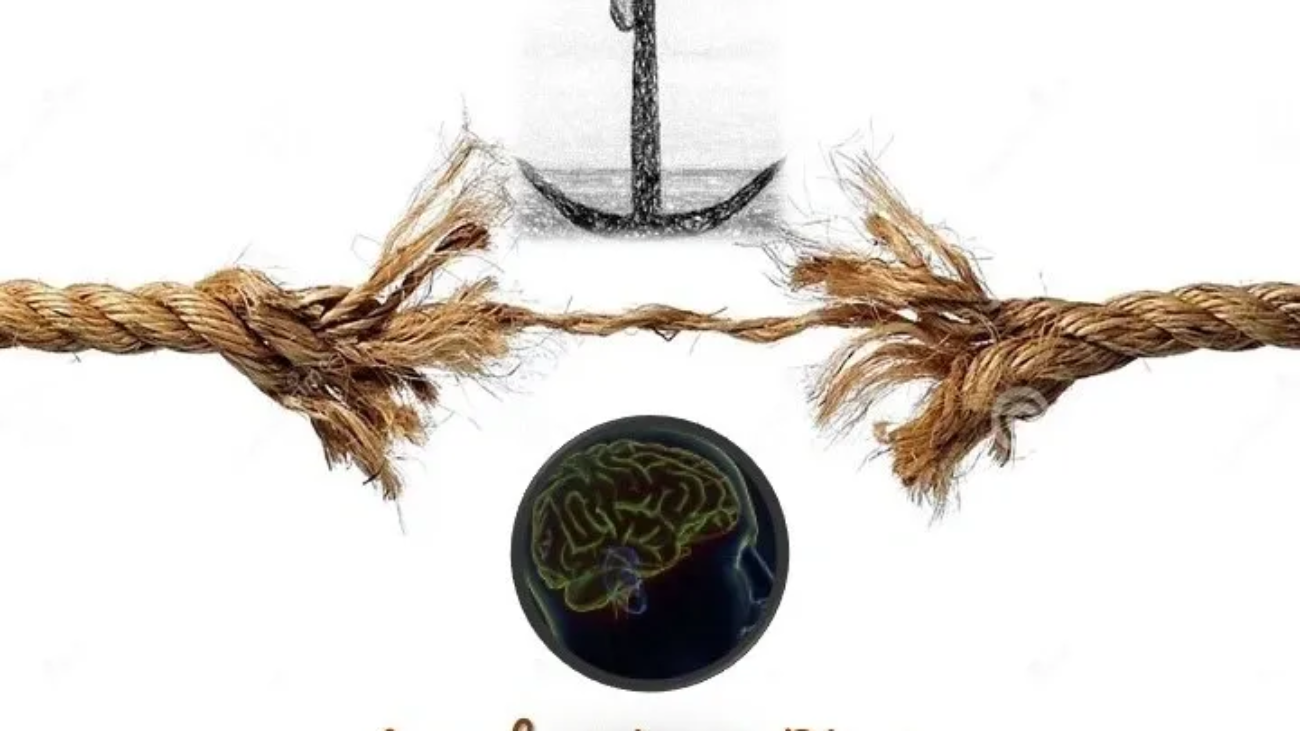
Anchoring Bias is a Cognitive Bias in which an individual’s decision is influenced or depends on the first piece of information or initial information received.
A common susceptible candidate to the anchoring bias are physicians when diagnosing patients where the initial impression about the patient often create an anchoring point. This may also lead to incorrect assessment of the patient’s problem.
Tversky and Kahneman in their research concludes the cause of anchoring-as-adjustment.
After an anchor is set, people adjust away from it to get to their final answer; however, they adjust insufficiently, resulting in their final guess being closer to the anchor than it would be otherwise.
Tversky, Amos; Kahneman, Daniel (1992). “Advances in prospect theory: Cumulative representation of uncertainty”.Journal of Risk and Uncertainty. 5 (4): 297–323.
Anchoring Bias influences our decision while purchasing new things like car, house etc. Someone tells you that a 5 year old sedan cost X and you do some research and find out that the rate is nearly around +/- 5% of X. So, you make up your mind accordingly and when you get a car at that price you are biased and is willing to pay and buy the car. In fact, you go on with your decision and purchase the car. You fail to look more options/ deals which may latter affect you negatively.
Next time, before deciding just PONDER…
Anchoring Bias has a powerful impact on the various decisions we make, for which we must give it a due diligence.
False Consensus Bias is the tendency of people to overestimate the level to which other people agree or share their beliefs, attitudes, and behaviours which leads to people thinking that others agree with them.
People also tend to overvalue their own opinions due to this bias. Since, people live or grow up in family or society where the thinking of the people are mostly similar, this bias starts developing. Further, if we are too much confident on an idea or viewpoint we fall prey into False Consensus Bias.
Researcher Lee Ross and his colleagues studied and came up with the term “False Consensus Effect or Bias”.
They asked students at Stanford University to walk around the campus for half an hour wearing a large sandwich board that read “Repent,” counting the number of people who spoke with them while they walked around wearing the sign. They wanted to compare the students who said yes and who said no. They found that students who agreed to do this unusual request believed that a clear majority of other students would also agree to do so. But the students who to do so believed that a clear majority of other students would also refuse. This tendency is known as the False Consensus Effect.
It was concluded that people often believe that there is more consensus—that is, more agreement—for what we say, think, and do than is really the case.
When we talk with someone, say about the performance of a team in a football match, we share our opinions and also thinks that the other persons also agree to our views. This is in simple sense nothing but our False Consensus Bias
Politicians and Leaders are normally the victim of False Consensus Bias as they think that people support them…
Ross, L., Greene, D., & House, P. (1977). The false consensus effect: An egocentric bias in social perception and attribution processes. Journal of Experimental Social Psychology, 13, 279–301.
Research suggests that the Hindsight Bias occurs due to the following three variables :
1. Distortion or Misremembering the earlier prediction about the event.
2. Tendency to view the event was to happen; inevitable.
3. Assuming that events could have been foreseen prior to occurrence.
While watching a tense game between a league topper and a bottom rung team, somehow the underdogs holding on to a draw till the last minute, and suddenly one comes up with the remark, “I knew beforehand that the match will end in a draw.” Maybe in reality that person was thinking otherwise.
This leads to overconfidence, strong belief for success. It happens while investing in stocks and it leads to taking too much unnecessary risks.
Hindsight bias has been found to occur more likely when the outcome of an event is negative than positive, [Schkade, D.; Kilbourne, L. (1991). “Expectation-Outcome Consistency and Hindsight Bias”. Organizational Behavior and Human Decision Processes. 49: 105–123] a phenomenon consistent with the more general tendency for people to pay more attention to negative outcomes of events than positive ones. [Fiske, S. (1980). “Attention and weight in person perception: The impact of negative and extreme behavior”. Journal of Personality and Social Psychology. 38 (6): 889–906.]
Researchers Roese and Vohs suggest that one way to counteract this bias is to consider things that might have happened but didn’t. By mentally reviewing potential outcomes, people might gain a more balanced view of what really happened.
We meet many such people in our day to day life, sometimes we too become victim of Hindsight Bias, knowingly or unknowingly. So, better be careful. This will help a lot…
Dunning-Kruger effect is a Cognitive Bias, in which a person thinks or believes that he or she is more smarter, capable and effective i.e. they are unable to make a realistic judgement of their own self and overestimate their capabilities.
This was developed after extensive research by two social psychologists, David Dunning and Justin Kruger.
A simple example is the marks scored by a candidate in an examination. Most of the candidates who feels that they scored less but were supposed to have secured more marks is a perfect case of Dunning-Kruger effect. Such candidate not only overestimate themselves in terms of their knowledge, capabilities etc. but they are also not doing a realistic assessment of their performance. They are never to succeed in the long run and will remain poor performers throughout unless they make a true assessment of self and are able to realize their own potential.
A simple way is to look at the results, do a self introspection, a detailed analysis on the outcome, accept the shortcomings and move ahead with better planning and more hard work.
It has been proved by various researchers that incompetent people are unable to accurately assess and recognize the quality of their own work and hence are poor performers, they are also. Further, such people think of themselves as better, capable, knowledgeable, more competent than others and are unable to recognize or assess or accept the good things, more competence people, resulting in the Dunning-Kruger effect
Dunning and Kruger suggest that this phenomenon occurs due to “dual burden.”
People are not only incompetent; their incompetence robs them of the mental ability to realize just how inept they are.
A person may have little knowledge on the subject but due to Dunning-Kruger effect he/ she may think of himself as an expert and starts delivering the expertise!!!!
In today’s world, we come across many such ‘knowledgeable’ persons, basically who knows the “various dots” but are “unable to connect these dots and make a line.” However, the annoying fact is that they never understand and start delivering the ‘dots” and often become a irritating factor.
Next time, when you meet such a person, just remember the Dunning-Kruger effect and make a plan to relieve yourself.
Happiness is our own; no one has control over it. But, we ourselves are to be blamed as we find each and every reason to be unhappy. In our day to day life it may not be always possible to be happy all the time, but if we try we can limit on our reasons for unhappiness and move into being a happy person.
Let’s try to be happy no matter what. A few steps may be to read various literature available;
One such good book to start with…
Steps towards happiness:
· Positive Mindset: Try to be in a positive set of mind. It’s difficult, but remember that when we discuss our pain with others, it only multiplies. So, share such only if there is a need to be happy, share with someone who can feel it, support and most important is that you feel like sharing i.e. to lighten your burden or source or reason of unhappiness and you expect some positive encouragement in return.
Remember to what Leo Tolstoy said, “One of the first conditions of happiness is that the link between Man and Nature shall not be broken.”
· Be at One with Nature: Learn from Nature. No matter what, how much we give sorrow, try to harm, disturb nature, we fail as Nature remains the same. The trees again grows after we cut, the flower still bloom even after we pluck, river flows even stopped and so on. So, we must learn from nature; be happy by setting asides our sorrows. Look forward..
· .Change Attitude: It is said the we try to change others than to change ourselves. The irony is that, if we are not able to change ourselves, how can we change others. Let out change our attitude, be positive and try to change our negativity with positive thoughts, action; somewhat an introspection of self in the positive direction.
· Be content: Another important aspect is to be content. If we are content, we are happy because we have all we want. Our desires stop and we do not look at others, compare and let the material possessions become the reason of our unhappiness. Be content with what you have and enjoy happiness forever.
· Gratitude: Just be grateful to everything; health, wealth etc. and be happy. I am grateful that you will read it, like it, comment and it will make happy. Even criticism, will make me happy after momentary anguish as it will help me to be a better person…
Please stop by and offer your valuable thoughts…SEE YOU SOON.
The dictionary definition of Confirmation Bias (noun) is the tendency to interpret new evidence as confirmation of one’s existing beliefs or theories. The term Confirmation Bias was coined by the English psychologist Peter Wason.
So confirmation bias is basically processing of information to confirm one’s previously existing beliefs or biases. It is a type of Cognitive Bias (a systematic thinking error which affects our judgements and decisions) where we try to search for or interpret information according to our beliefs. So, due to our confirmation bias, we tend to give more importance to those information which helps us to prove our point and make up our case, even if such information is totally non-relevant.
One of the most common areas where Confirmation Bias leads to negativity or negatively impacts the outcome is the priocess of talent acquisition, mostly through personal interviews.
A candidate comes a bit shabbily dressed for a position where the basic job demand is for a well dressed person. At the first sight, majority of the interviewers believes that the candidate is not suitable for the post. Once the questioning happens the interviewer seeks for information to substantiate his/ her belief and so the questions happen accordingly. Even if the candidate is able to successfully answer to the questions, the Confirmation Bias remains and opportunity is sought for to confirm the already decided hypothesis “Unsuitable for the post.” On the other hand, if the candidate is unsuccessful in answering the questions, then the questions are always in the same area or topic to fully confirm the belief. The candidate is unable to answer and so the hypothesis is accepted.
In very rare occasions, in the above example, the Conformation Bias of the person is proved wrong. This is due to the rational thinking of the person, ability to overcome his beliefs and make decision based on evidence or information.
Life is beautiful, happier, if we overcome our Confirmation Bias…
I am trying and hope to succeed. Will You?????
Thank You very much for reading; hopefully you liked and shall be of use to use.
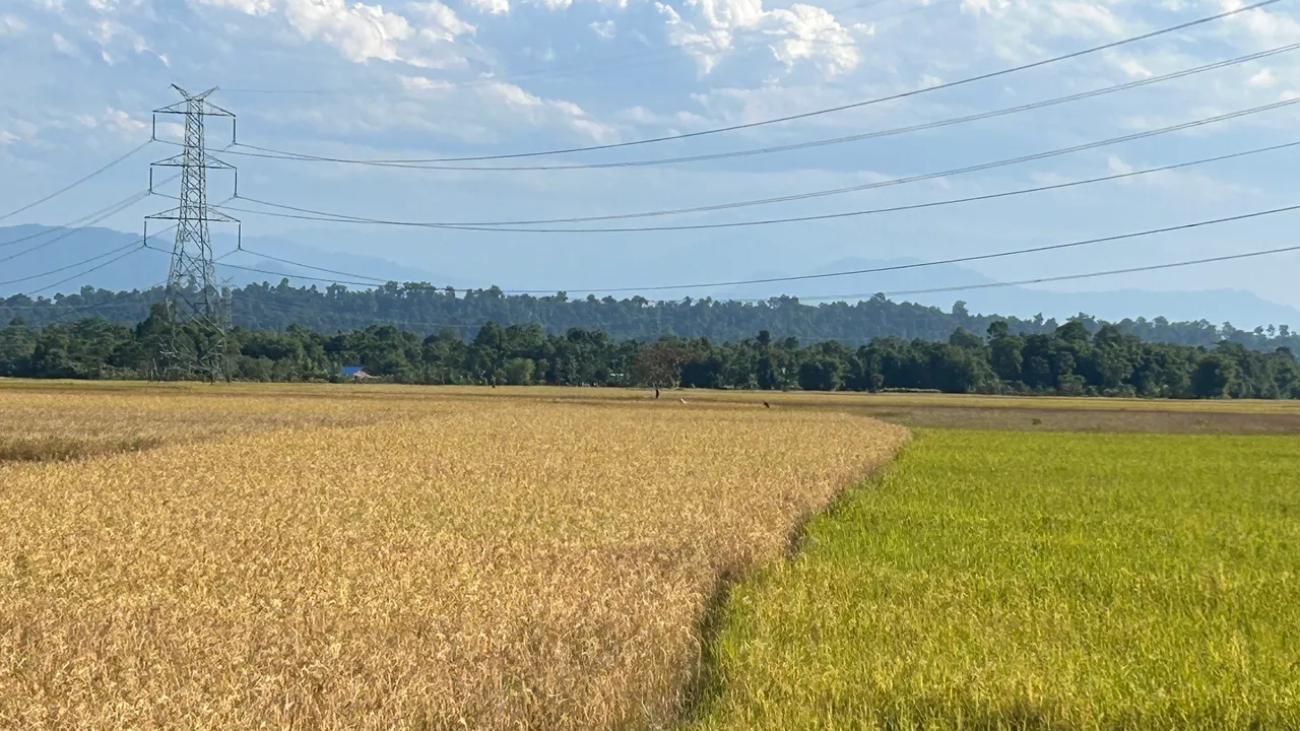
Pasighat, a 108 year old town of Arunachal Pradesh, India is the headquarter of East Siang District of the state. A picturesque town, mostly inhibited by the Adi people, is also said to be the oldest town in the state is on the banks of river Siang, which is the mighty river Brahmaputra after entering the plains of the state of Assam.
Towards east around 5 kms away from the main point of the tow, one reaches the ‘Ranaghat Bridge’ over River Siang. Just as you approach the bridge, you take a left and move downwards and you will find the Selfie Point of “I Love Pasighat”.
Ranaghat Bridge… over River Siang…. about 5 kms from Pasighat Town
Sirki Waterfall, about 12 from Pasighat, it is a must visit. The road starts to ascend into the hills and after driving for approx 20 minutes enjoying the beauty of the hills you reach the destination. The steps are steep and at the end of the steps, climbing you reach the first phase of the waterfall. Next, is the more arduous climb, with no steps, over the stones, luckily a water pipe to hold and balance. the climb is really difficult but worth. Its just WoW…
Road to Sirki Waterfalls from Pasighat TownSirki WaterfallsSirki Waterfalls
Sangam, the confluence of two water bodies; where the Green Water of River Siyom meets the Murky Water of River Siang as seen by us and is a natural phenomenon which is to be seen in a lifetime. Its around 70 kms drive from Pasighat and on the road towards Aalo. After crossing the Pangin town, which is bypassed, another 5-6 kms of road, that will require good driving skills, one reaches the point. But, the pain of driving was ably rewarded by the spectacular view…
Sangam – the confluence point of River Siyom and River Siang
As there is no bridge to cross the River Siang at Panging, the Komsing Hanging Footbridge(around 395-metre-long ) is the the only mode of communication for nearly 9,000 villagers spread across eight villages was constructed long back. There is a wooden motorable bridge over the River Siyom which connects a place called ‘Medog’ and from that point one should go towards right without crossing the bridge by driving uphill to reach the Hanging Footbridge. Again, when we reached the site, it was really astonishing, a cautious walk on the footbridge over the River Siang is really a treat…
Komsing Hanging Footbridge
When in Pasighat, just opt out for adventure and visit “Sirki Falls”, “Sangam” and “Komsing Hanging Footbridge”. The road conditions have definitely improved now.
The drive uphill from Pasighat(headquarter of East Siang district, Arunachal Pradesh, India) till now was enjoyable, amidst the beauty of nature and the mountain curves. Less traffic and habitat made it more enjoyable.
However, as lunch time was approaching, with no eateries seen, we were a bit apprehensive. Suddenly, by the roadside, a wooden construction, deemed to be a hotel in future, few semi-permanent shops, mostly made of bamboo and wood, women selling vegetables and oranges and another hotel, luckily was open, brought the light back in our faces. Wife started chatting with the ladies and purchased oranges, papaya, chillies and lemon; a la organic ones. I went to the hotel and was delighted to find that food including Maggi will be available till 3 pm.
As, we were about to restart our journey towards the confluence point of River Siyom and River Siang, an old man with shorts, a hat and the traditional Knife hanging came and chatted with me. After asking about where I work and after saying that I work in an oil company, he surprised me by uttering the name of my beloved company Oil India Limited. I was so touched, that in such a remote corner, we are able to make an impact. I asked him about the distance to our destination, but he was unable to understand and could not make out. As, I took the name of Panging(a small town in Arunachal Pradesh, India), he seemed to understand and told that the place is called ‘Sangam’. It will be more than an hour’s ride and some portion of the road are not in good condition due to landslides and the occasional rain. Nothing such could deter us from undertaking our journey to the destination. He then inquired politely if we could give a lift to her cousin (sister’s daughter) to Panging as she has to carry back half a sack of rice, some vegetables and a blanket. She had come from Panging to collect these as she stays in a hostel there to study. I readily accepted which was also agreed upon by my wife and son, as we three were only travelling and we had enough space to accommodate her. But, I made a request that if possible she could guide us to ‘Sangam’ and the ‘Komsing Hanging Footbridge’ which was gladly accepted.
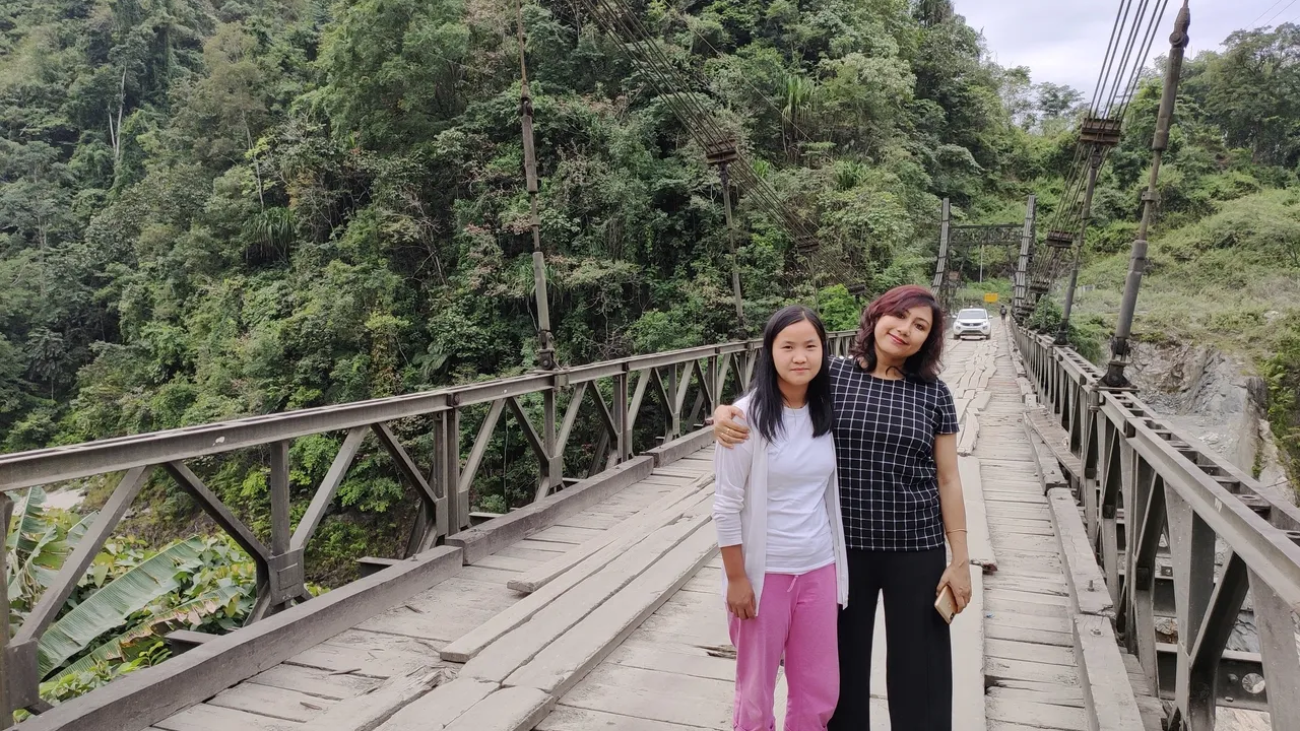
Nupur in White & Pink dres with Mausumi in the the wooden bridge (motorable) over the River Siyom connecting Boleng
The shy young girl introduced herself as ‘Nupur’ in Hindi, student of Govt. High School, Panging. She stays in a rented accommodation with her elder sister to pursue her studies. Her home is across the River Siang amidst the hills, in a place called ‘Medog’. As there is no bridge to cross the River Siang at Panging, the Komsing Hanging Footbridge (around 395-metre-long and the only mode of communication for nearly 9,000 villagers spread across eight villages) was constructed long back for communicating. The distance from Panging to the Komsing Hanging Footbridge is 13 km which is about 30 minutes’ drive through the hilly terrain with poor road condition. But, she along with her sister has to track 17 kms to reach her home after crossing the Komsing Hanging Footbridge, and the total time taken is around 3 to 3 ½ hours due to the hilly terrain. Each time they go home, they carry essential items back home and bring back other necessary items like rice, vegetables etc., the weight carried on their back equaling to around 25 to 30 kgs. We were shocked and speechless after hearing her.
Sangam – Confluence point of River Siyom and River Siang
To our astonishment, she just smiled and said that it is a part of their life and they are happy. Seemed like; ‘Oh, it’s nothing.’ She also added with a smile, that they are lucky as there are other villages which are much far away with no means of communication expect foot. She also informed that she had gone to her aunt’s house in the morning travelling though ‘Sumo’, the only public vehicles that ply across and was waiting for her return. These ‘Sumos’ leave to Pasighat from Aalo( headquarter of West Siang district, Arunachal Pradesh, India) (110 kms ; 4 hours ride) in the morning and return back in the afternoon, reaching Panging by around 2 PM. Most of these vehicles are overcrowded due to inadequate number of vehicles and we were so much happy and satisfied with our decision to give her a ride. So, it’s a bit easier for her to fetch things from her aunt’s house than her own home.
Her guidance helped us to reach ‘Sangam’ and ‘Komsing Hanging Footbridge’ with ease.
On our return journey, after dropping her, we were just uttering; Why life is so different?
For her, the track of 17 kms for 3 ½ hours with a 30 kg weight on her back is a necessity; a means to survive and for others it’s a pleasure. It is her routine and for people like us it’s a thrill, once or twice in a lifetime, maybe.
But, her smile and non-complaining attitude won our heart.
Komsing Hanging Footbridge
It reminded me of a quote by Thomas Paine, an American philosopher and revolutionary,
“I love the man that can smile in trouble, that can gather strength from distress, and grow brave by reflection”.
Lesson learned and Belief Reinforced,
“Let’s be content and happy; To Enjoy life with Gratitude.”
May God Bless her… Please Pray for her success and well being…
I was looking outside the window and was engraved in the beauty of nature when a few rain drops brought me in senses. The first thing that came to my mind was that I should get a Rickshaw, once I get down to take me home. By the time the bus reached the bus-stand, it was raining heavily and no one was around. It was about to be dark and I was a bit worried. As I landed my foot on the ground, I saw an old man with a Rickshaw waiting for me. It felt like a God sent a gift for me. He welcomed me with a smile and addressing me as ‘daughter’ asked me the intended place I want to go. I got up quickly as it was still raining and directed him towards my home. As he starts paddling, he starts a conversation by saying that rain may be pain for others, but it is a boon for him. When it rains, he is always available and so he gets passengers. As I didn’t respond, was out of my mind a bit due to the work overload, he asked me whether I was annoyed with him for him calling me as ‘daughter’. His question brought me back to my senses. I said that its fine as I am the age of his daughter, further I also told him that due to the weather and a hard day’s work I was a bit absent minded. I felt like, he was trying to say something, or in this rain why he would try to start a conversation. With my encouraging words, he was boosted up and sought my permission to speak about himself and his family, if I intend to hear. I was eager to hear his story and asked him to speak. He started by telling that his family leaves far away in his native place. He lives a simple plain life and with the savings, he had educated his two daughters and got them married to good families. He only son has graduated and is now preparing for UPSC Exams. In fact, he has cleared the Prelims. He also told me that if someone clears the UPSC Exams, he/she can become a Deputy Commissioner or Superintending of Police of a District, pointing out to the Office of DC that we just crossed. He also said that, whenever he meets his son after long gaps, since the latter’s childhood, he used to make his son dream of becoming a DC or SP after growing up. In fact, he took his son to the district headquarters to show the office and residences of DC / SP. I expressed my surprise and satisfaction and acknowledged his contribution and said that may God bless him and his son with success to achieve the goal as the mains exam were at hand. The conversation ended as I reached home.
I forget about the incident, until a few months later I again saw him at the bus-stand. I waved at him and he immediately recognized me and the ride began. I asked him about his son. With grief he informed that his son was unable to clear the mains. However, he has not lost hope and has started preparing with full force. Altogether, now he has started taking tuitions and is managing his expenses. With the money earned, he has enrolled himself in coaching and is fully determined to crack the exam. I found the person a bit worried, he was talking about getting his son married. I suggested him to wait for another couple of years and then decide as he no longer needs to send money to his son. He was relieved and thanked me and asked to pray for his son’s success.
This is one of the many examples / real life stories of a father dreaming of his son/ daughter becoming someone of status in society. One important ingredient of this is that every father wants his son/ daughter to become someone of greater heights than himself. But, to dream big, really big, like this person, the person has to be special. This person was special. He had a caring heart, cared for his family and others, even the people he carried. He himself said that he did not have any bad habits. His vision was clear and he planned, took steps towards its achievement. He inculcated in the young minds of his son the seeds of his dream. His son too was able to live up to the expectations of his father.
Money is never a hurdle, although it makes the journey easier. High ethical standards, caring for others, preparing a roadmap, are some of the traits which helps in achievement of one’s goal.
Road to success is tough but not impossible if we try honestly and conscientiously.
Positive body language helps to create a positive impact. We all know it and always strive for it, but, sometimes it happens that for some reason or the other at the end we flatter. Why such happens…
In the context of appearing in an interview, what are the signs of nervousness which can be termed as non-desirable body language or posture???
A candidate comes, sits down and then starts to fiddle with his/her hair, touches the nose, touches or wipes the forehead, looks towards the roof/ceiling while answering are very common signs of negative body language/ postures which creates a negative impact.
These are signs of nervousness, which is always there for any person during the start / initial phases of an interview. However, the sooner one overcomes such nervous gestures its better. Coupled with a few tricky questions by the panel, the matter becomes worse.
Albert Mehrabian, Professor Emeritus of Psychology, UCLA, master on the relative importance of verbal and nonverbal messages. His “7%-38%-55% Rule”, for the relative impact of words, tone of voice, and body language when speaking emphasises 55% on Body Language, 38% on the tone of voice and only 7% on the words spoken.
Many literatures are readily available in the market/ world wide web.
The key is to study and practice to overcome the negative signs/ postures.
Body Posture
Sitting neutral, a bit straight is the best as Leaning back may indicate that you are lazy, arrogant, easy going; leaning forward shows aggression, slouching is just worse, lazy. Too much hand gestures are signs of negativity.
Crossed Arms
May mean hostility, closed, arrogance. So, the best posture is to keep the arms either on the side or on the lap. It indicates openness, approachability. Hands on the back or pockets indicates frigidity, arrogance.
Avoiding Eye Contact
Sign of nervousness, lack of confidence. Distracted or upward eye movements suggests lack of confidence in the answer or simply lying. Good eye contact shows confidence, attentiveness. Occasional nodding head on agreement with eye contact makes a desirable positive impact. Beware, not to stare or nod on everything.
Handshake
Initiate the handshake to show confidence. A handshake should be of comfortable grip, not too strong, not too loose. Avoid sweaty hands, be careful.
Fidgeting
No fidgeting. Fiddling with your hair, adjusting your collar/ tie, touching the nose, wiping the forehead are signs of nervousness, insecurity and creates negative energy. A common perception, people who touch their faces while answering questions are dishonest. Leg wobbling / fiddling, tapping the floor, playing with objects in the table or with pen/ pencil are some other negative acts.
Not Smiling
Not Smiling / Stone Faced does all the bad that is not desirable. A smile is a sign of warmth, comfort, acknowledging and makes the interviewers at easy and creates a pleasant atmosphere.
Only one solution; Practice, Practice andPractice.