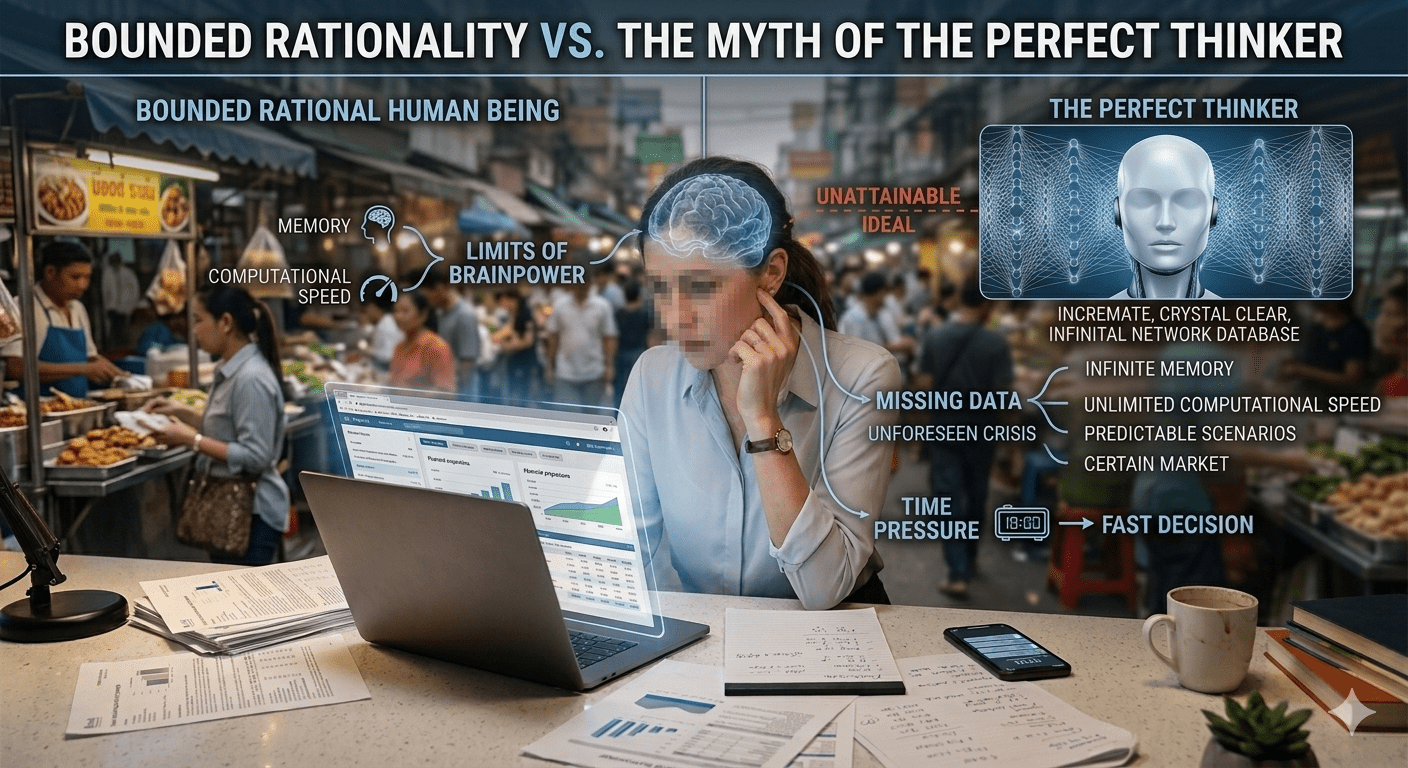
We like to think we make flawless financial choices. We imagine ourselves weighing every option, calculating every discount, and picking the absolute best deal, i.e the perfectly logical creature of economics textbooks, the “Economic Man.”
But let’s be honest. Have you ever walked into a market, completely overwhelmed by the noise, the traffic, and thirty different vendors yelling out prices for the same bananas, and just bought from the first stall/ vendor you saw? If you have, they you are a normal human being, congrats.
A brilliant thinker named Herbert Simon looked at how humans actually make choices. He researched extensively and came to the concuslion that we, humans are not supercomputers. We as humans, normally weighing the options, not every available option; calculating discounts, not every discount, and then picking up the best deal as we presume, which may not be the best, but we are satisfied and make the purchase/ deal.
Simon first laid out the core idea that human decision-making is limited by cognitive capacity and organizational constraints, challenging the classical economics assumption of perfect rationality. He then introduced the foundational concept of Bounded Rationality in his landmark 1947 book, Administrative Behavior.
Simon argued that human rationality is “bounded” (or limited) by three major things: the limited information we have, the limited processing power of our brains, and the limited time available to make a decision.
Instead of searching forever for the perfect choice, humans practice what Simon called “satisficing”—a combination of satisfying and sufficing. We choose the option that is simply “good enough.”
Let us discuss Bounded Rationality in more simpler terms.
1. The Boundary of Information (We Can’t Know Everything)
The “Economic Man” knows the exact price and quality of every product everywhere. In reality, we operate in a fog.
Imagine you are shopping for a Muga Silk Mekhela Chador for a wedding. To be a purely economic thinker, you would need to visit every single weaver in Sualkuchi, check every shop in Fancy Bazar, and test the exact chemical purity of the silk threads in a lab. Because you cannot possibly access or process that much data, you rely on trust. You buy from a shop your aunt recommended, hoping the quality is good and the price is fair. Your decision is rational, but it is bounded by the information you have.
2. The Boundary of Brainpower (Our Brains Get Tired)
Our brains cannot calculate complex mathematical probabilities on the fly. When faced with too many choices, our mental processors overheat.
Think about booking a holiday trip to Kaziranga National Park. You are flooded with choices: dozens of resorts, varying jeep safari packages, hidden resort fees, and fluctuating fuel costs. A supercomputer would calculate the exact utility-to-cost ratio of every single combination. Your human brain, however, experiences “choice overload.” After scrolling through three travel websites, you get tired, pick a mid-range resort with decent photos, and say, “This looks fine.” You didn’t find the absolute best mathematical deal, but you found one that satisfies your basic needs.
3. The Boundary of Time (The Clock is Ticking)
In textbooks, decisions happen in a vacuum. In the real world, time runs out.
Imagine the chaotic rush hour at the Jalukbari rotary in Guwahati. You need to get to Khanapara quickly. To be purely rational, you should pull over, analyze live satellite traffic data for three different routes, calculate the wear-and-tear cost on your vehicle per minute of idling, and check real-time fuel prices. But you don’t have twenty minutes to sit and calculate. The bus behind you is honking, cars are cutting you off, and you are already late. You make a split-second decision based on your gut instinct and take the bypass. It might not be the mathematically perfect route, but it gets you moving.
The Beauty of Being “Good Enough”
Herbert Simon’s concept of bounded rationality changes how we view ourselves. It proves that when we make “impulsive” or “imperfect” choices, we are not necessarily being stupid or lazy. We are simply adapting to a complex world with limited cognitive resources.
The “Economic Man” is a lonely, robotic fiction. He spends his entire life calculating, never experiencing the joy of a spontaneous purchase or the comfort of a trusted local vendor.
By accepting our bounded rationality, we realize that human survival doesn’t require us to be perfect. In a world full of infinite data and chaotic markets, being “good enough” is actually the smartest choice we can make.